Berlusconi ‘The Diplomat’ by Emidio Diodato & Federico Niglia
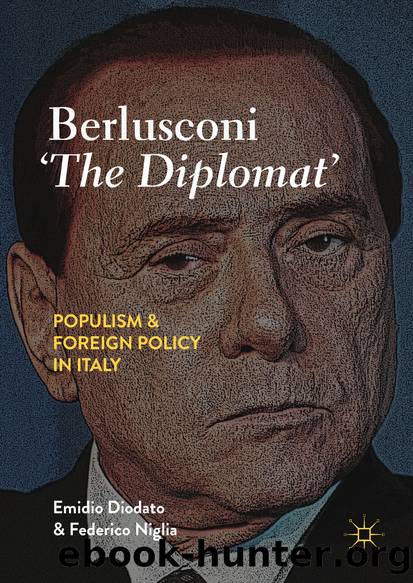
Author:Emidio Diodato & Federico Niglia
Language: eng
Format: epub
ISBN: 9783319972626
Publisher: Springer International Publishing
5.2 From Afghanistan to Libya : Italian Dilemmas on War and Peace
Apart from the importance of the renovated alliance with the Lega Nord , which led the center-right to victory, the election result of May 13, 2001, was a sort of referendum on Berlusconi and his capacity for leadership. Most of the international press had amplified the echo of the judicial inquiries, including money laundering, relations with the mafia, and tax evasion. Despite this controversial aura, Berlusconi achieved a clear victory and managed to govern the country for the entire legislature, breaking the record of the duration of governments. It has been noted that, compared to 49 million voters, the highest number attributable to Berlusconi (whose name was in the symbol of the coalition) is 18 million, so that “31 million Italians did not vote for Berlusconi” (Galli 2004, p. 49). However, we should consider that the voters were 40 million (81.38% of the electorate), with 1.5 million blank cards, and almost 2 million invalid cards. Then, the preferences for Berlusconi reached 51% of the electorate (Ministero dell’Interno 2001).
The wide parliamentary majority obtained in the elections, and the unusual prospect of at least five years in office, gave the impression that the second Berlusconi government could pursue important foreign policy initiatives. In the past, governments had always had to watch their backs for the frequent collapses of coalitions. The push toward the center-right in Italy, however, went against the trend in other EU countries where governments were largely of the center-left. Gerhard Schröder was German chancellor, Lionel Jospin was the head of government in France, even if with Jacques Chirac as president, and Tony Blair was prime minister in the United Kingdom. Moreover, in a climate of permanent electoral campaign, regional and European electoral appointments would have ended up weakening the executive. Administrative elections in May–June 2003, the 2004 European elections and, above all, the regional elections of April 2005, were not positive for the center-right. This is the reason why in 2005 it was necessary to form a third Berlusconi government.
Ruggiero, one of the most respected Italian diplomats, agreed to become foreign minister. He was a figure of great experience, both internationally and as regards national institutions. Furthermore, Ruggiero accepted to take charge of the Farnesina with the support of Henry Kissinger and the influential Italian industrialist Gianni Agnelli (Hill 2001). Ruggiero had negotiated Italy’s entry into the European Monetary System, and he was a staunch defender of European integration as the only solution to the structural problems of Italy. The leader of the opposition, Piero Fassino , had regular meetings with Ruggiero keeping himself informed of the government’s initiatives.
At the Laecken European Council on December 14–15, 2001, there was further confirmation of the desire to adopt a line of continuity with the past. The European Council decided to establish a convention for the European Constitution, and Berlusconi proposed Giuliano Amato as Deputy President, who had been prime minister in the previous center-left government. According to journalist Giuliano Ferrara
Download
This site does not store any files on its server. We only index and link to content provided by other sites. Please contact the content providers to delete copyright contents if any and email us, we'll remove relevant links or contents immediately.
| Africa | Americas |
| Arctic & Antarctica | Asia |
| Australia & Oceania | Europe |
| Middle East | Russia |
| United States | World |
| Ancient Civilizations | Military |
| Historical Study & Educational Resources |
Room 212 by Kate Stewart(5203)
The Crown by Robert Lacey(4879)
Endurance: Shackleton's Incredible Voyage by Alfred Lansing(4863)
The Iron Duke by The Iron Duke(4420)
The Rape of Nanking by Iris Chang(4276)
Joan of Arc by Mary Gordon(4172)
Killing England by Bill O'Reilly(4065)
Say Nothing by Patrick Radden Keefe(4062)
I'll Give You the Sun by Jandy Nelson(3516)
Shadow of Night by Deborah Harkness(3432)
Hitler's Monsters by Eric Kurlander(3412)
Eleanor & Park by Rainbow Rowell(3272)
Blood and Sand by Alex Von Tunzelmann(3257)
Mary, Queen of Scots, and the Murder of Lord Darnley by Alison Weir(3256)
Darkest Hour by Anthony McCarten(3186)
Margaret Thatcher: The Autobiography by Thatcher Margaret(3133)
Book of Life by Deborah Harkness(2996)
Red Famine: Stalin's War on Ukraine by Anne Applebaum(2979)
The One Memory of Flora Banks by Emily Barr(2912)
